When Zarathustra was thirty years old, he left his home and the lake of his home, and went into the mountains. There he enjoyed his spirit and solitude, and for ten years did not weary of it. At last his heart changed - and rising one morning with the rosy dawn, he went before the sun, and spoke thus unto it:
"Thou great star! What would be thy happiness if thou hadst not those for whom thou shinest!"
String Basses
So the book Also sprach Zarathustra: Ein Buch für Alle und Keinen (Thus Spoke Zarathustra: A Book for All and None) by Friedrich Nietzsche begins. It is a book of religious doctrine set as a novel that has as its main character a mythical prophet named Zarathustra that is based on the antique Persian prophet Zoroaster, the founder of one of the first monotheistic religions in the world, Zoroastrianism. But Nietzsche's Zarathustra is purely mythical and face of the similarity of name has nothing to do with the actual prophet. Nietzsche's prophet is a instructor of changing morals, engaging mankind to overcome itself and come to be the 'superman'. The book delves into many philosophical issues and challenges, and as the above example shows, it is a lot to wade through, not only for the branch matter but the style in which it is written. Nietzsche wrote it in the style of scripture, perhaps partly to mock original scripture. In the book is also the first time Nietzsche used the phrase 'God Is Dead', which has lead to a lot of misuse and meanings that have small to do with the context in which it is used in the book.
#1 Sale Now Yamaha SLB-100 Silent Electric Upright Double 4-String Bass
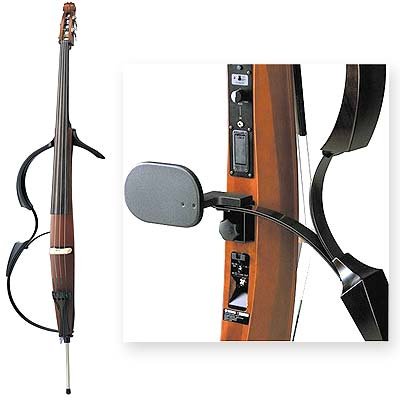
Yamaha SLB-100 Silent Electric Upright Double 4-String Bass Feature
- Maple Neck - Spruce and Mahogany Body - Ebony Fingerboard - Maple Bridge Which Is Height Adjustable - Beech and Aluminum frame - Custom Worm Gear Type Tuning Pegs - Ebony Tail Piece
- 2 Piezo Pickups - Aux IN With Level Control - Headphone/LINE OUT - Volume Control - Tone Control
- Contra Ball-End Bass Strings - String Length Is 1,054 mm(41,5'') - Dimensions With The Frame Attached And The End Pin Fully Contracted Is 1,735mm(L)x525mm(W)x453mm(H)mm or 68,3"(L)x20,7"(W)x17,1"(H) - Weight Is Approximately 10 kg (22 lbs.3 oz)
- Manganese Battery Life Is Approximately 12 Hours - Alkaline Battery Life Is Approximately 24 Hours
- Optional equipment includes an optional stand giving you a place to park your Silent Bass when not being played and an optional soft case, which is equipped with a strap for easy transport and offers space for the knee support.
Yamaha SLB-100 Silent Electric Upright Double 4-String Bass Overview
If you've been looking for an alternative to lugging around that big acoustic bass of yours, or you want a great sounding electric upright to add to your electric instrument arsenal, the Yamaha SLB-100 Silent Electric Upright Double 4-String Bass delivers a serious sound that is meant to be heard. A member of Yamaha's Silent String Series, the SLB-100 is designed to offer bassists a compact, easy to transport instrument that feels, plays and sounds as close to the real thing as possible. Played pizzicato or with a bow, this instrument delivers solid full-bodied tone making it an excellent choice for any jazz or pop gig. Internal electronics let you simply plug in and play without the need of any external preamplification. Remove the detachable frame and everything slips into the optional soft case making transport to and from the gig easier than an acoustic. The solid body of the Yamaha SLB100 Silent 3/4 Bass uses a 3-ply design that virtually eliminates unwanted feedback yet delivers full-bodied tone. A Detachable frame provides the most natural feel and support of the Instrument. Removal is easy and offers added portability of the instrument. Dual piezo pickups located under the bridge deliver the optimum tone quality. The adjustable bridge height and a pickup balance control let you tailor the feel and response of the instrument to individual needs. Internal electronics allow plug and play operation without the need of external preamplification. A Headphone/Line Out jack offers versatile connectivity and AUX In Jack allows for the connection of a CD player, MD player or cassette deck. The SLB-100 operates on either battery power (DC9V) or the optional AC power supply PA-3B. The BKS1 Knee support (supplied) attaches to the back of the instrument's body to provide added support of the instrument.Available at Amazon Check Price Now!
Related Products
Customer Reviews
*** Product Information and Prices Stored: May 16, 2012 17:00:07
Strauss himself said the following about the work:
"I did not intend to write philosophical music or to portray in music Nietzsche's great work. I meant to carry by means of music an idea of the amelioration of the human race from its origin, through the discrete phases of its development, religious and scientific, up to Nietzsche's idea of the Superman. The whole symphonic poem is intended as a homage to Nietzsche's genius, which found its many expression in his book Thus Spake Zarathustra."
The book is divided into about eighty separate lesson headings, with each lesson ending with the words 'Thus spoke Zarathustra, which explains the title of Strauss' work. He uses nine of the lesson headings in the score.
Einleitung, oder Sonnenaufgang (Introduction, or Sunrise) - perhaps the most recognizable opening of any piece of classical music, it as been used in movies and by rock stars, which is quite a tribute to its power and attraction. Strauss' sunrise brings the new religious doctrine of Zarathustra with a low rumbling and then the first appearance of the 'World Riddle' motif of C-G-C, somewhat of a tonal ambiguity that is resolved but briefly when the third for the chord is heard shortly after, but then it is immediately flattened. The mystery has already begun. The sections ends in a grand splash of sound from the orchestra, and the three-note World Riddle motif is heard in discrete guises throughout the rest of the work.
Von den Hinterweltlern (Of those in Backwaters) - discrete translations of this contain 'Of those in the hinterlands'. Strauss divides the string section into ten groups that play a rich progression of harmonies that climaxes into a soaring motif for the violins. The starting of this section quotes the Credo in unum Deum (I believe in one God) from the Catholic Mass. So are the ones in the backwaters, or hinterlands, the ones who are the traditionally religious?
Von der großen Sehnsucht (Of the Great Longing) - The great longing continues with the original religious theme as the organ quotes the Magnificat. Is the Great Longing the desire of the traditionally religious to be near to God and to use religion to try and solve the World Riddle?
Von den Freuden und Leidenschaften (Of Joys and Passions) - The joys and passions of Zarathustra's youth are pondered upon. What were they, how could they have been used more for the advantage of mankind that no satisfy a desire?
Das Grablied (The Song of the Grave) - With the arrival of the dawn and a new philosophy, Zarathustra knows there is no longer any way or theorize to go back to the way things were. Hence, they are buried in the grave.
Von der Wissenschaft (Of Science and Learning) - Strauss uses the learned fugue to report science. His fugue branch is made up of all twelves notes of the scale and represents science's exertion to encompass, contain and by comparison the World Riddle. Indeed, the three note motif is the first three notes of the subject.
Der Genesende (The Convalescent) - Science in interrupted by of all things, a dance tune. But science comes back aggressively, makes its case with a shout. After a brief pause the orchestra wanders until it finds the kernel of the dance tune already heard.
Das Tanzlied (The Dance Song) - The dance tune progresses into a full-fledged, romantic-era Viennese waltz.
Nachtwandlerlied (Song of the Night Wanderer) - Midnight is heard tolling, the work ends in the World Riddle being plucked out by the string basses, and the woodwinds in turn play a separate motif. The work ends in a more sever tonal ambiguity than which it began, the ambiguity of the World Riddle in neither major or minor key, and the other motif in B Major. Is there any answer? Are there any answers? Or is true wisdom attained with the realization that there are no concrete answers to the World Riddle, and that the write back is in fact is no write back at all, but the acceptance of things that can't be changed and the striving to turn the things that can be changed.
One of the most engaging interpretations of the work comes from an record written by Marin Alsop titled Alsop Sprach Zarathustra. A snippet from the article, I could not state it better myself
"Strauss takes Nietzsche's work and distills it into eight musical sections, with an introduction and epilogue. through these sections, he wants to carry the essence of Nietzsche's philosophical advent to the world. Nietzsche wanted us, as human beings, to consider our value theory and, rather than blindly believe in a monotheistic god or in the advancing scientific field, start to hold ourselves accountable for our own actions.
Whether you ascribe to that religious doctrine or not has no bearing on the fact that this music, composed so painstakingly by Strauss, holds the power to profoundly move us."
Strauss - Also Sprach ZarathustraRecommend : band and orchestra Drum sets Recording Equipment Signal Processors Drumsticks, Mallets and Brushes

No comments:
Post a Comment